

Despite federal law setting the minimum age to purchase tobacco products, including vapes, at 21 since December 20, 2019, underage access remains a significant issue. Weak enforcement, state-level inconsistencies, and gaps in verification systems allow minors to bypass these restrictions easily. Here's a quick breakdown of the key challenges:
- Conflicting Laws: Some states still enforce lower age limits or lack provisions to suspend retailer licenses for violations.
- Retail Failures: Many stores rely on visual ID checks, which are prone to error. In 2022, 43.1% of underage users reported buying vapes from retail sources.
- Online Loopholes: Weak age verification on websites and delivery systems makes online purchases accessible to minors. Over 76% of online vape retailers fail to verify IDs properly.
- Unregulated Vending Machines: Self-service sales often bypass ID checks, and enforcement of vending machine rules is inconsistent.
- Product Misclassification: Some manufacturers exploit loopholes by marketing nicotine-free or synthetic nicotine products to dodge regulations.
Key Solutions:
- Automated ID Scanning: Advanced systems can verify IDs instantly and reduce human error.
- Stronger Online Verification: Require government ID uploads and biometric checks for online sales.
- Retailer Accountability: Enforce stricter penalties, mandatory training, and regular compliance checks.
- Eliminate Self-Service Access: Ban vending machines in non-adult-only locations and enforce strict oversight.
- Close Classification Loopholes: Regulate all vaping products, including synthetic nicotine and accessories.
These steps are critical to reducing youth access to vaping products and addressing the gaps in enforcement.
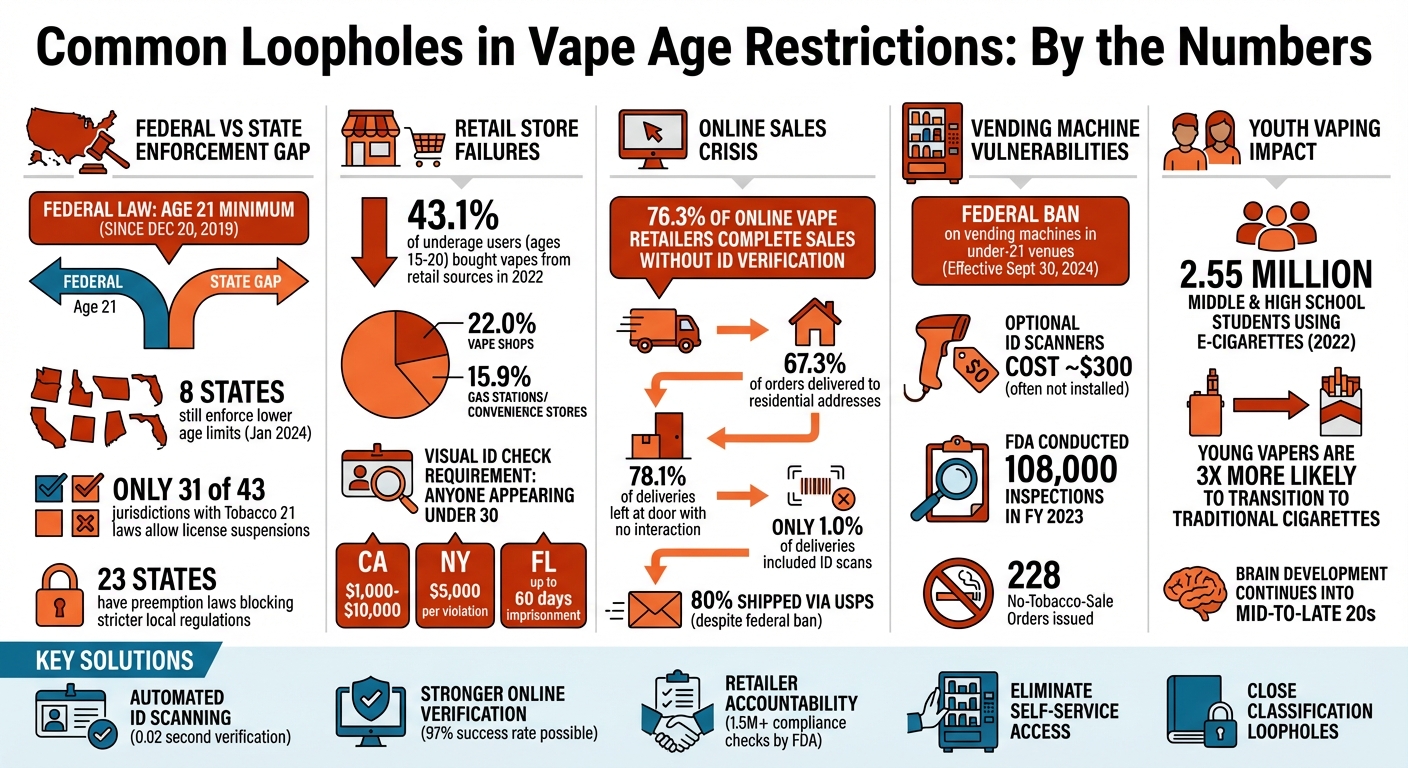
Vape Age Restriction Loopholes: Key Statistics and Enforcement Gaps
Conflicting Federal and State Laws
Federal Age 21 Requirement vs. State Laws
The Tobacco 21 law, enacted on December 20, 2019, established a nationwide minimum age of 21 for purchasing tobacco products. Yet, as of January 2024, eight states still enforce lower age limits. This discrepancy creates a significant enforcement challenge. State tobacco control systems rely heavily on their own statutes to give local authorities the power to monitor retailers and impose penalties.
When state laws still permit sales to individuals under 21, local inspectors may find themselves without the legal authority to suspend or revoke a retailer's state-issued license for selling to someone aged 20. This leaves retailers facing fewer consequences for breaking the law. While the FDA can issue warnings and fines, it lacks the authority to revoke state licenses. Among the 43 jurisdictions with state-level Tobacco 21 laws, only 31 include provisions allowing license suspensions or revocations for underage sales violations. These inconsistencies create a patchwork enforcement system, complicating efforts to uphold the federal standard.
How Legal Confusion Weakens Enforcement
The disconnect between federal and state laws doesn’t just create enforcement gaps - it also leads to confusion among retailers and regulators. For instance, some state statutes still fail to classify e-cigarettes as "tobacco products", meaning vapes often fall outside licensing and penalty frameworks.
"Federal enforcement may be limited by funding and other constraints, and must cover all retailers across the country. Federal policy priorities are thus often accomplished in collaboration with the states."
– Summer Sherburne Hawkins, Drug and Alcohol Dependence Reports
Adding to the complexity, 23 states have preemption laws that stop cities and counties from enacting stricter regulations than those at the state level. This becomes a major hurdle when communities face a rise in youth vaping. Local officials, wanting to impose tougher rules, are often blocked by state law. These enforcement gaps can be exploited by minors, ultimately weakening the impact of the federal age requirement.
Weak ID Verification at Retail Stores
Problems with Visual Age Checks
Federal regulations require retail employees to verify the photo ID of anyone who appears under 30 when purchasing vaping products. The issue? Relying on visual age estimation is far from accurate. A customer who seems to be 25 could actually be 19, and this dependence on guesswork, paired with quick mental math, often leads to mistakes. These missteps allow underage buyers to slip through the cracks and make purchases.
While many point-of-sale systems include reminders for cashiers to check IDs, these prompts don’t physically block the transaction. A cashier can simply bypass the warning with a click and complete the sale. In some cases, retailers require employees to input a customer’s date of birth manually. However, this system is also flawed - clerks can enter fake birthdates or use override codes to skirt the rules.
These gaps in verification make it easier for retailers to sidestep age checks entirely, as illustrated in the examples below.
Retailers Who Don't Check IDs
These verification issues contribute to a troubling statistic: in 2022, 43.1% of current e-cigarette users aged 15–20 reported obtaining their devices from retail sources. The main offenders? Vape shops accounted for 22.0% of youth purchases, while gas stations and convenience stores were responsible for 15.9%.
"Vape shops, in particular, have been found to implement less vigorous age verification methods, relative to other retail sources." – Truth Initiative
Penalties for failing to comply with age verification laws vary widely by state. In California, first violations can lead to fines ranging from $1,000 to $2,000, with maximum penalties reaching $10,000. New York imposes a $5,000 fine per violation, and repeat offenses may escalate to a Class E felony. Florida allows for up to 60 days of imprisonment for intentional violations, while Alabama’s fines range from $100 to $1,500 depending on the number of offenses.
The FDA tries to curb these violations through undercover inspections. First-time offenders usually receive a warning letter, but repeated violations can result in Civil Money Penalties or No-Tobacco-Sale Orders, which bar retailers from selling tobacco products altogether. Despite these measures, enforcement remains inconsistent, and many retailers continue to sell to underage customers without facing serious repercussions.
These weaknesses in verification and enforcement undermine the effectiveness of age restriction laws, leaving room for underage sales to persist.
Study reveals loopholes in vaping laws, calls for stricter oversight
Online Sales and Age Verification Failures
While physical stores wrestle with enforcing ID checks, online platforms face their own set of challenges when it comes to keeping age-restricted products out of minors' hands.
Missing or Weak Verification Systems
Online vape retailers are often the easiest route for underage buyers to get their hands on restricted products. Many of these websites rely on basic "age gates" - pop-ups asking users to confirm their age or input a birthdate. These measures are incredibly easy to bypass.
A study conducted by UC San Diego in October 2023 found that 76.3% of online vape retailers allowed customers to complete their purchase without any form of ID verification. Furthermore, 67.3% of these orders were delivered to residential addresses, and only 1.0% of deliveries included ID scans to confirm the recipient's age.
"Age-gating technology on these websites doesn't actually work. People will not tell the truth when they enter their age, and it's remarkably easy for kids to get tobacco products mailed to them." – Thomas Carr, Director of National Policy, American Lung Association
Shockingly, 78.1% of vape deliveries were completed without any interaction between the buyer and delivery personnel - packages were simply left at the door. Another 15.2% of buyers spoke with delivery personnel but were never asked to show identification.
Adding to the problem, 80% of orders are shipped via the U.S. Postal Service, despite federal regulations banning its use for such deliveries. The postal service often doesn't enforce strict age-verification protocols, making it a go-to option for retailers looking to avoid the costs of compliance.
These gaps in the system give minors a clear path to exploit online sales.
How Minors Bypass Online Safeguards
Underage buyers take advantage of these weak systems in several simple ways. The easiest method? Entering a fake birthdate on the age gate. Since there’s no verification process behind it, this barrier is more symbolic than functional.
Payment methods also provide an easy workaround. Minors often use preloaded Visa e-gift cards or borrowed credit cards to make purchases on websites that don’t match billing information with age databases. Because these payment methods don’t require the purchaser’s identity to align with the cardholder’s, they allow underage buyers to slip through unnoticed.
Some online sellers even go a step further by actively enabling minors. They advertise "discreet shipping" on platforms like TikTok, marketing it as a way for young buyers to hide their purchases from parents and bypass shipping safeguards. To avoid scrutiny, some sellers also mislabel their products as non-tobacco items during shipping.
"We knew that there is a well-established system for monitoring brick-and-mortar retailers' compliance with tobacco policies, but there is not one for online sales." – Raquel Harati, Lead Study Author, University of California San Diego
Another major issue is the cost of proper verification systems. Third-party age verification software can cost retailers thousands of dollars each month. This expense often pushes smaller or less scrupulous sellers to skip these safeguards entirely. As a result, a divide emerges: responsible retailers invest in proper verification, while others operate with minimal oversight, creating easy targets for minors seeking to bypass regulations.
sbb-itb-773acc2
Self-Service Displays and Vending Machines
Unattended physical sales, like self-service displays and vending machines, add another layer of concern in efforts to limit underage access. These setups often bypass key safeguards, making them an easy target for misuse.
Access Without Cashier Oversight
Self-service displays and vending machines operate without human supervision, which makes it easier for minors to bypass age restrictions. Designed for 24/7 convenience, these machines eliminate in-person ID checks - one of the simplest but most effective tools for keeping age-restricted products out of the hands of minors.
Some vending machines come with snap-on ID scanners, but these systems lack the judgment of a human cashier. A minor could easily use someone else’s ID, like an older sibling’s or a friend’s, to complete a purchase. Prioritizing speed over accuracy, these machines are often found in nightlife hotspots - bars, clubs, and convenience stores - where oversight is minimal. This lack of robust safeguards creates an environment ripe for enforcement failures.
Inconsistent Enforcement of Vending Machine Rules
Federal regulations banning tobacco vending machines in venues admitting anyone under 21 will go into effect on September 30, 2024. However, the enforcement of these rules is inconsistent, and restrictions on where machines can be placed are often weak.
In many states, self-service displays and vending machines remain unregulated. For example, North Carolina's Vapor Registry Law does not address these devices, leaving a significant gap in protections for minors. While some proposals, like "Solly's Law", push for outright bans, most states have yet to adopt these measures.
Even when advanced technologies like biometric facial recognition or automated ID scanning are available, they’re often optional rather than mandatory. For instance, snap-on ID scanners cost about $300, and operators frequently skip installing them, leading to inconsistent safeguards.
The FDA performed 108,000 tobacco retailer inspections in Fiscal Year 2023, issuing 228 No-Tobacco-Sale Orders for repeated violations. Yet, vending machine operators can remotely adjust settings or even relocate machines, making it difficult for regulators to keep up.
This mix of weak placement rules, optional verification tools, and the ability to manage machines remotely creates a tough enforcement environment. The result? A glaring loophole that makes it easier for underage individuals to gain access.
Product Misclassification Loopholes
Misclassifying vaping products creates opportunities for manufacturers to sidestep regulations, allowing retailers to skip age verification. This practice weakens efforts to prevent minors from accessing these products and adds to the regulatory challenges already in place.
Nicotine-Free Products and Accessories
The FDA oversees a wide range of vaping components - such as batteries, coils, atomizers, and even zero-nicotine e-liquids - because they are designed for use with tobacco products. However, certain items, like lanyards or decorative cases, are explicitly excluded from tobacco regulations. This creates a loophole where nicotine-free products can be sold without stringent ID checks, making it easier for minors to later pair them with nicotine from other sources.
When the FDA introduced flavor restrictions for closed-system cartridges but not disposables, it triggered a sharp increase in the popularity of disposable vapes. These products saw their market share jump from 24.7% to nearly 52%, as manufacturers adjusted their classifications to exploit the regulatory gap. In response, the FDA issued warning letters in July 2020 to 10 companies, including Cool Clouds Distribution Inc. (known as Puff Bar), for marketing flavored disposables without proper authorization.
These tactics not only take advantage of existing regulatory gaps but also pave the way for new loopholes, such as the rise of synthetic nicotine.
Synthetic Nicotine and New Products
Before 2022, many manufacturers turned to synthetic nicotine to dodge the FDA's authority, which was originally limited to tobacco-derived nicotine. By 2021, synthetic nicotine products had grown from virtually non-existent in 2020 to taking up two-thirds of vape shop shelf space.
"We're not going to stand by as bad actors are profiting off the sale of illegal products that are addicting our nation's youth."
– Brian King, Director, FDA Center for Tobacco Products
Congress acted in March 2022, closing this loophole through the Consolidated Appropriations Act, which extended the FDA's authority to cover nicotine from any source. However, by then, the market had already been flooded with synthetic nicotine products, often marketed with terms like "tobacco-free", "pure", or "clean", potentially misleading consumers about their safety. In June 2023, the FDA issued warning letters to 189 convenience stores and vape shops for selling unauthorized flavored disposables, with a particular focus on Elf Bar.
The rapid spread of these products continues to challenge regulators. Addressing these classification loopholes is a critical step in tightening age-restriction enforcement and reducing underage access.
How to Close Age Restriction Loopholes
Addressing age restriction loopholes requires a mix of technological advancements, consistent policy enforcement, and holding retailers accountable. While the tools to tackle these issues are already available, the real challenge lies in applying them uniformly across all sales platforms.
Require Automated ID Scanning
To fix the shortcomings of manual ID checks, automated ID scanners offer a reliable solution by verifying the date of birth on IDs. These systems scan the 2D barcode on the back of driver’s licenses and state-issued IDs, ensuring accurate and quick validation. Some advanced systems go a step further, using Optical Character Recognition (OCR) to cross-check details like names and ID numbers. Document authentication technology can even verify over 4,000 global ID formats and detect tampering or forgeries instantly.
Modern scanners perform these tasks in just 0.02 seconds, making them both fast and effective. Additionally, 3D liveness detection adds another layer of security by confirming that the person presenting the ID is physically present. This technology matches a live selfie with the photo on the scanned ID, blocking attempts to use photos, masks, or deepfakes. With the FDA mandating ID verification for anyone under 30 purchasing tobacco products starting September 30, 2024, these tools are becoming essential.
Strengthen Online Age Verification
For online sales, simple "Yes/No" age gates are no longer enough. Instead, third-party verification systems and biometric authentication have become the gold standard. These methods require customers to upload a government-issued ID and a real-time selfie for facial recognition matching. By adopting these measures, online retailers can close significant loopholes.
Take FRUITIA x Fifty Bar Disposable Vapes, for example. They’ve implemented strict age verification protocols on their website, completing the process in under 30 seconds with a 97% success rate. Another safeguard is Adult Signature Required (ASR) delivery, which mandates ID scanning by the courier upon package delivery. Yet, a 2023 study found that only 1.0% of online vaping product deliveries actually scanned IDs as required, and 78.1% of buyers reported no interaction with delivery personnel.
Eliminate Self-Service Access
Self-service sales pose another challenge. Federal rules already ban vending machine sales of e-cigarettes in locations where anyone under 21 is allowed. However, enforcement remains inconsistent. Limiting vending machines to adult-only venues, such as bars that verify age at the door, and placing vape products behind counters ensures that every purchase involves trained staff.
"Decades of science have shown that keeping tobacco products away from youth is critical to reducing the number of people who ultimately become addicted to these products and suffer from tobacco-related disease and death."
– Brian King, Ph.D., M.P.H., Director of the FDA's Center for Tobacco Products
As of August 2024, the FDA has conducted over 1.5 million compliance checks on tobacco retailers. These efforts have resulted in more than 33,000 civil money penalties and 230 no-tobacco-sale orders for violations. Retailers who repeatedly fail compliance checks risk receiving a No-Tobacco-Sale Order (NTSO), which prohibits them from selling tobacco products for a set period.
Improve Retailer Training and Compliance
Technology alone can’t solve the problem - proper training is just as critical. Retailers need access to compliance checklists and ongoing updates on FDA regulations. Programs like "This is Our Watch" provide digital tools to ensure accurate age verification. Additionally, mandatory retailer licensing enables authorities to monitor compliance and swiftly suspend or revoke licenses for those who allow underage sales.
Regular audits and secret shopper programs also help keep retailers accountable. For USA-made products, such as those from FRUITIA, emphasizing responsible sales practices reinforces their commitment to quality and compliance. Together, these measures create a strong framework that protects minors while supporting responsible retailers.
Conclusion
Addressing the gaps in vape age restrictions isn't just about adhering to regulations - it’s about safeguarding young people from serious health risks. Nicotine exposure during adolescence can disrupt brain development, which continues into the mid-to-late 20s. Alarmingly, young e-cigarette users are three times more likely to transition to smoking traditional cigarettes compared to those who don’t vape. With approximately 2.55 million middle and high school students reported to be using e-cigarettes in 2022, the urgency to close enforcement loopholes cannot be overstated.
Fortunately, there are practical, technology-based solutions available to limit underage access. Tools like automated ID scanning, robust online verification systems, removal of self-service displays, and focused retailer training can make a real difference. However, inconsistencies persist. For example, a 2023 study revealed that only 1.0% of online vape deliveries fully met ID scanning requirements. Bridging this gap is critical.
"Inadequate compliance with existing sales regulations suggest greater national and local policy enforcement, including fines and license confiscation for selling to minors, is required at the retailer level." - BMC Public Health
Recent efforts have shown that strict compliance from both retailers and manufacturers is achievable. FRUITIA x Fifty Bar Disposable Vapes offer an example by enforcing robust age verification measures and producing USA-made products to ensure consumer safety. When retailers commit to stocking compliant products and verifying age at every transaction, they contribute to the solution.
To truly protect young people, policymakers, retailers, and manufacturers must work together to enforce consistent standards and implement verified sales practices that keep vaping products out of the hands of minors.
FAQs
How do state laws create conflicts with the federal vape age limit?
Some states still permit vape sales to individuals as young as 18, creating a clear conflict with the federal law, which sets the minimum age at 21. On top of that, lax age verification methods - particularly for online orders and deliveries - make it far too easy for minors to get their hands on vape products.
This mismatch underscores the importance of tighter enforcement and consistent rules across the board to align with federal law and keep vaping products out of the hands of underage users.
How do minors manage to bypass age restrictions when buying vapes online?
Minors often find ways to sidestep online age restrictions. They might use fake or borrowed IDs, input a parent’s or friend’s payment information, or take advantage of basic age-verification systems - like entering a random birthdate that isn’t cross-checked. Some even turn to VPNs or proxies to mask their location or set up disposable email and social media accounts to fly under the radar.
To tackle these loopholes, businesses need to step up their game. Advanced ID scanning, multi-factor authentication, and real-time verification can make it much harder for underage users to gain access. Additionally, retailers should consider implementing stronger monitoring systems to ensure they’re staying on top of age-restriction compliance.
How do vending machines make it easier for underage individuals to access vapes?
Vending machines make it harder to enforce age restrictions on vaping products because they operate without real-time ID checks or supervision. Unlike stores where staff can verify a customer’s age, vending machines dispense items automatically, creating a loophole that minors can exploit.
One way to tackle this problem is by introducing stricter rules, such as installing ID-scanning technology on these machines or restricting their placement to areas where only adults are allowed. These measures could help prevent underage access to vape products.