

The FDA regulates every aspect of the vaping industry, from manufacturing to marketing. Since the Deeming Rule in 2016, all vape products require FDA authorization to be legally sold. With only 39 products approved by January 2026 and 54% of vape products on the market classified as illegal, staying compliant is critical to avoid steep fines or shutdowns. Here’s a quick breakdown of how to stay on the right side of the law:
- Submit PMTAs: All vape products introduced after 2007 need FDA approval. Use updated forms and ensure scientific data supports your application.
- Register and List Products: Facilities must register annually by December 31, and product listings must be updated twice a year.
- Manufacture in FDA-Registered Facilities: Products made in unregistered facilities are illegal and subject to enforcement actions.
- Follow Labeling Rules: Include nicotine warnings and avoid marketing that appeals to minors.
- Monitor Regulations: Regularly check the FDA’s authorized product lists and comply with state-specific laws.
Failure to comply can result in fines up to $21,348 per violation, product seizures, or legal action. By following these steps, you can protect your business and operate within the law.
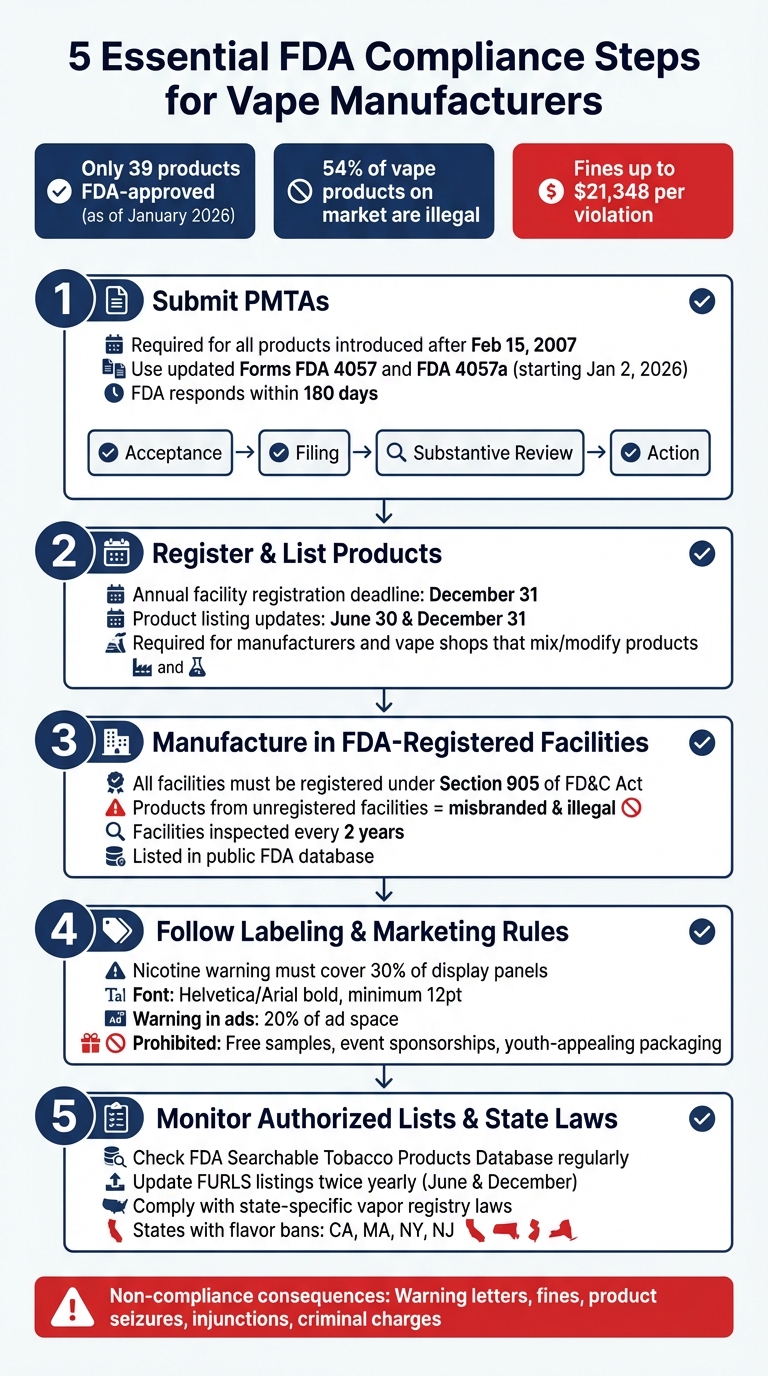
5 Essential FDA Compliance Steps for Vape Manufacturers
Tobacco Product Compliance Policy: Updates for Manufacturers
1. Submit Premarket Tobacco Product Applications (PMTAs)
For vape manufacturers, navigating the PMTA process is a must. Any vape product introduced after February 15, 2007, needs FDA authorization. The application must include scientific data proving the product is "appropriate for the protection of public health", which essentially means showing that its benefits outweigh its risks. This requirement ensures a thorough evaluation process before a product can hit the market.
Starting January 2, 2026, manufacturers are required to use updated Forms FDA 4057 and FDA 4057a. Using outdated forms will result in an RTA (Refuse to Accept) action. To avoid unnecessary delays, validate Form FDA 4057b with the FDA's Product Form Validator Tool 2.0 before submission.
"A PMTA must provide scientific data that demonstrates a product is appropriate for the protection of public health."
- U.S. Food and Drug Administration
The PMTA review process has four phases: Acceptance, Filing, Substantive Review, and Action. At the end of this process, the FDA will issue either a Marketing Granted Order or a Denial Order. By law, the agency must respond to a complete application within 180 days, though more complex submissions may require additional time. This makes submitting accurate and complete applications on time absolutely essential.
To cut research costs, manufacturers can rely on existing data or published studies. Proprietary data can also be shared via Tobacco Product Master Files (TPMFs). For e-liquids with different nicotine levels, grouped submissions using Form FDA 4057b are allowed, but each product still requires its own environmental assessment. Meeting these detailed requirements is key to staying compliant and legally marketing vape products.
2. Register Establishments and List Products
If you're involved in manufacturing tobacco products, e-liquids, or vaping devices in the U.S., you must register your facility with the FDA and list all your products. This rule also applies to vape shops that mix or modify products. Registration isn’t a one-time deal - it needs to be renewed annually by December 31. Additionally, product listings must be updated twice a year, by June 30 and December 31, whenever there are changes to your offerings.
This process is more than just a formality. Non-compliance can lead to serious consequences, as the FDA enforces these regulations strictly. For example, FRUITIA x Fifty Bar Disposable Vapes ensures full compliance with these rules.
The risks of not keeping your registration up to date were made clear in June 2020, when the FDA issued a warning letter to Jadore Enterprises, LLC (operating as Tiki Vapes). The company failed to renew the registration for its Asheboro, NC facility. As a result, the FDA classified its "Tiki Vapes - Spearmint" e-liquid as misbranded because it was made in an unregistered facility.
"Failure to address any violations... may result in FDA's taking regulatory action. These actions may include, but are not limited to, civil money penalties, no-tobacco-sale orders, seizure, and/or injunction." - Ann Simoneau, J.D., Director, Office of Compliance and Enforcement, Center for Tobacco Products
Under section 903(a) of the FD&C Act, products made in unregistered facilities or not properly listed are considered misbranded. Misbranded products cannot be legally sold or distributed, and the FDA may take actions like product seizures, civil penalties, or injunctions. To stay compliant, ensure your facility is registered by December 31 each year and update your product listings on time to avoid these penalties.
3. Ensure Manufacturing in FDA-Registered Facilities
Once you've established the importance of facility registration, the next step is to ensure that all manufacturing happens in FDA-registered facilities. For vape products to be legally sold, they must be manufactured in compliance with FDA regulations. According to Section 905 of the FD&C Act, any facility involved in manufacturing, preparing, compounding, or processing tobacco products is required to register with the FDA. This includes businesses that mix e-liquids or modify vaping devices.
Using facilities that are not registered with the FDA makes products "misbranded" and therefore illegal. This can lead to serious consequences like product seizures, injunctions, and civil penalties. Companies such as FRUITIA x Fifty Bar Disposable Vapes comply with these regulations by ensuring all their manufacturing is conducted in properly registered facilities. This underscores the critical role of accurate registration details, which will be discussed further.
"A tobacco product is deemed misbranded if it was manufactured, prepared, propagated, compounded, or processed in an establishment not duly registered under section 905." - FDA Guidance for Industry
When registering a manufacturing facility, you'll need to provide detailed information, including the facility’s full name, address, and owner or operator details. For corporations, this also includes the names of all officers and directors. To avoid database errors, it's essential to obtain a D-U-N-S number for each facility. The FDA advises using the Tobacco Registration and Product Listing Module – Next Generation (TRLM NG) for quicker and more efficient processing.
Facilities that are registered with the FDA are subject to inspections every two years and are listed in a public FDA database, which allows for easy compliance verification.
sbb-itb-773acc2
4. Adhere to Labeling and Marketing Restrictions
Once manufacturing requirements are met, the next step is ensuring strict compliance with labeling and marketing standards. The FDA mandates that every nicotine-containing product must display the warning: "WARNING: This product contains nicotine. Nicotine is an addictive chemical." This warning must cover at least 30% of the principal display panels, using Helvetica or Arial bold font, no smaller than 12 points. The text must be black on a white background (or vice versa), centered for visibility. For products too small to include the warning, it must instead appear on the outer packaging, wrapper, or a securely attached tag.
Advertising rules are just as rigorous. Ads must include the nicotine warning on at least 20% of the ad space, framed by a 3–4 mm thick rectangular border [34, 36]. Additionally, terms like "light", "mild", or "low" are only allowed if the product has received an FDA Modified Risk Tobacco Product order. Free sample distribution, event sponsorships (athletic, musical, or social), and marketing branded merchandise like hats or lanyards are strictly prohibited [29, 34].
The FDA pays close attention to marketing that could appeal to minors. For example, in May 2018, the FDA and FTC issued 13 joint warning letters to companies selling e-liquids packaged to resemble juice boxes, candies, or cookies. Some products even included items like lollipops or mimicked food products such as apple juice, which could be identified by scent alone without opening the packaging. In December 2018, Electric Lotus received a warning for their product "Cereal Treats Crunch", which closely resembled Cinnamon Toast Crunch cereal.
"There's no excuse for this sort of packaging and we'll continue to target these products and the companies that market them." - Scott Gottlieb, M.D., Commissioner, FDA
Violations of these standards lead to enforcement actions. The FDA typically starts with a warning letter, giving companies 15 business days to submit a plan to address the issues. If the problems aren’t resolved, penalties escalate and may include fines, product seizures, or injunctions. Additionally, products with improper labeling are classified as "misbranded" under the FD&C Act, making them illegal for sale [35, 13]. Regular audits and updates are essential to ensure ongoing compliance.
FRUITIA x Fifty Bar Disposable Vapes has taken steps to meet FDA packaging standards and avoid imagery that appeals to minors. Conducting regular reviews of marketing materials to eliminate youth-targeted designs or unauthorized health claims is a proactive way to maintain compliance.
5. Monitor Authorized Product Lists and State Laws
Keeping up with federal and state regulations is just as important as maintaining strict manufacturing practices and facility registrations. Staying informed about regulatory updates ensures your products remain legal in the market and accessible to consumers.
As of early 2026, the FDA has authorized only 39 tobacco- and menthol-flavored e-cigarette products for lawful sale in the U.S.. Any product without this authorization is classified as adulterated and misbranded, making its sale illegal. To stay compliant, manufacturers should regularly consult the FDA's Searchable Tobacco Products Database. This tool helps verify product status and track any Marketing Denial Orders issued by the agency. While federal regulations set the baseline, state-specific rules add another layer of complexity.
State laws often impose additional requirements. Several states, including North Carolina, Wisconsin, and Mississippi, have implemented vapor registry laws. These laws mandate that manufacturers certify their products as FDA-authorized or have a pending PMTA before they can be listed on state-approved directories. For instance, North Carolina's directory, effective July 1, 2025, restricts sales to only those products included in the listing. Meanwhile, states like California, Massachusetts, New York, and New Jersey have gone a step further by banning all flavors except tobacco.
Failing to meet these requirements can lead to severe consequences. In May 2023, the FDA issued an import alert for Esco Bars after rejecting its PMTA, highlighting the risks of non-compliance.
"Any product that doesn't have authorization is on the market illegally." - Brian King, Director, FDA Center for Tobacco Products
Manufacturers need to stay proactive. Updating product listings in the FDA Unified Registration and Listing System (FURLS) twice a year - typically in June and December - is a crucial step. Additionally, verifying that products are correctly listed on state directories in every market where they are distributed is essential. Regularly reviewing state-specific regulations helps ensure compliance as laws continue to evolve.
Conclusion
Meeting FDA compliance standards isn't just a formality - it’s a legal necessity. Failing to comply can lead to serious consequences like warning letters, hefty fines, product seizures, injunctions, or even criminal charges. Products that skip proper registration are labeled as "misbranded" under FDA regulations. The agency is known for its strict enforcement, and manufacturers who overlook these requirements risk not only their reputations but their entire businesses. Taking compliance seriously is a cornerstone of long-term success.
"FDA is committed to working quickly to transition the current marketplace to one in which all tobacco products have undergone a careful, science-based review by the agency and have met the statutory standard." - FDA
To stay on the right side of the law, follow the compliance tips outlined earlier. Submitting a proper PMTA, keeping your facility registration up to date, and adhering to strict labeling rules are non-negotiable steps. Remember to register annually by December 31 and update product listings by both June 30 and December 31. Stay informed by checking the FDA's Tobacco Product Marketing Orders webpage, and make sure your packaging steers clear of designs that could appeal to children, like those resembling candy or snacks.
FAQs
What is the PMTA process for vape manufacturers?
The Premarket Tobacco Product Application (PMTA) process is a requirement set by the FDA for vape manufacturers who want to legally sell their products in the United States. As part of this process, manufacturers must submit a comprehensive application detailing their product's ingredients, design, manufacturing methods, and scientific data that supports its safety.
In addition to this, manufacturers need to demonstrate that their products meet FDA standards and maintain thorough records to show ongoing compliance. This system is designed to ensure vape products are carefully assessed for quality and safety before they are made available to consumers.
How often do vape manufacturers need to renew their FDA registrations?
Vape manufacturers must renew their FDA registrations every year. This yearly update is crucial to staying compliant with federal regulations and avoiding possible penalties. Keeping up with this requirement is not just about following the rules - it’s also key to protecting your business’s ability to operate and its reputation in the industry.
What happens if vape manufacturers don’t follow FDA regulations?
Failing to follow FDA regulations can bring serious trouble for vape manufacturers. The FDA has the authority to issue warning letters, levy fines, or even confiscate products that don’t meet the required standards. In more severe cases, legal action may be taken, which can damage a brand’s reputation and throw business operations into chaos.
To steer clear of these risks, vape manufacturers need to stay up-to-date on FDA requirements and ensure their products fully comply with the rules. Staying proactive is key to protecting both the business and its reputation.